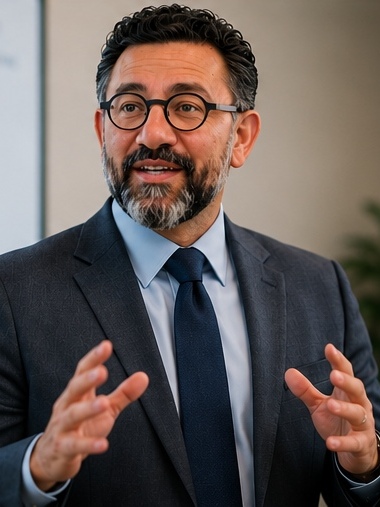
Why do organizations produce the results they produce? That question has anchored more than 20 years of executive leadership across healthcare and professional services, multi-division business operations, and higher education — and, more recently, doctoral research that turned practical experience into a formal framework for organizational change and performance.

Jonathan's career spans more than 20 years across executive leadership, operations, healthcare consulting, professional services, workforce management, organizational development, and executive leadership within a higher education institution. The common thread is a sustained interest in how organizations function, and how they can function more effectively.
Jonathan's experience ranges from business turnaround and multi-division operations to consulting with medical-practice owners and leading healthcare consultants, to his current role as a senior academic and institutional executive. Rather than a series of unrelated career moves, each stage has brought increasing exposure to organizational complexity — from executing within an operation, to advising organizations from the outside, to leading a professional-services function at scale, to sitting inside the executive leadership of an institution navigating governance, regulation, and change.
That range is the point: Jonathan has sat on the operating side, the advisory side, and the executive side of the same class of problems — growth, regulatory complexity, institutional change — and has since formalized what that experience taught him into a body of applied research.
What tends to distinguish that work in practice is less a checklist of skills than a way of reading an organization. Given a complex situation, Jonathan's instinct is not to reach for the obvious fix, but to ask what is actually producing the result in front of him — to separate the symptom everyone is reacting to from the constraint underneath it. That instinct shows up the same way whether the setting is a struggling operating unit, a healthcare practice, or a higher education institution.
Jonathan's Doctor of Business Administration in Organizational Leadership formalized a question his practice had already been raising for two decades: why do organizations produce the results they produce, and how can leaders tell the difference between a symptom and the underlying problem? His doctoral research developed the Integrated Process, Change, and Performance (IPCP) Framework, and his applied work since has continued to test and extend it in real organizational settings.
The relationship runs in both directions. Experience surfaced the questions worth studying; the research, in turn, has sharpened how Jonathan diagnoses and advises on organizational problems in practice. That progression — experience, inquiry, research, application — is described in more depth under Research & Publications.

A distinct discipline in its own right, grounded in Jonathan's doctoral study: organizational design and structure, culture and culture-change theory, systems thinking, and diagnostic methods for understanding why an organization produces the results it does before intervening.
Leading and supporting organizational change, transformation, alignment, implementation, stakeholder engagement, and adaptation during periods of growth, disruption, and institutional development.
Aligning structure, people, processes, accountability, management systems, and performance measures to improve organizational outcomes.
Building operating systems, strengthening execution, developing management routines, scaling teams, improving accountability, and translating organizational objectives into coordinated action.
Leadership development, workforce strategy, organizational development, performance management, executive coaching, management capability, and team effectiveness.
Experience within regulated environments involving governance, policy systems, regulatory communication, compliance documentation, organizational readiness, accreditation preparation, and executive and board-facing support.
Scope, not a scoreboard — the range of organizations and people this experience has touched:
Jonathan's research and his executive practice inform one another directly. Each of the works below began as a practical operating question and was developed into a formal framework or model — then tested again in practice. This body of work is evidence of how Jonathan thinks about organizational problems, not just what roles he has held.

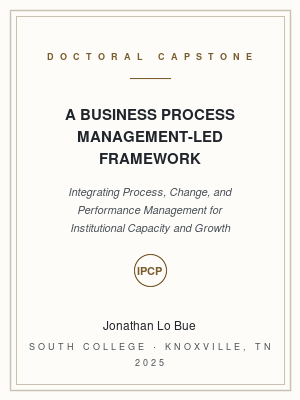
Jonathan's doctoral capstone investigates why newly established online colleges so often lack a coherent operating model — and develops the Integrated Process, Change, and Performance (IPCP) Framework as the answer: a structured model that integrates process design, organizational and cultural change, and performance monitoring to strengthen institutional governance, adaptability, and capacity. Set against the regulatory environment of the Florida Commission for Independent Education, the study builds an implementation plan aligned with FLCIE and DEAC accreditation standards, turning the framework into a practical, replicable strategy for other emerging institutions. The IPCP Framework is the organizing model behind Jonathan's subsequent applied work.
Read the capstone →
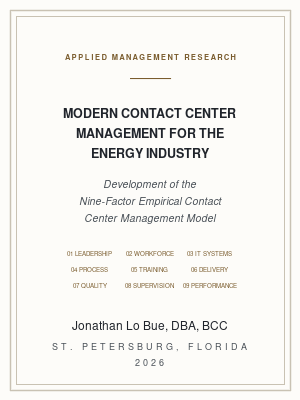
Built from Jonathan's direct executive leadership of inbound and outbound contact center operations serving the deregulated energy industry, this work asks what actually separates a contact center that performs from one that doesn't. The resulting model identifies nine interdependent factors — executive leadership, workforce selection, information technology infrastructure, standardized operational processes, employee training, quality service delivery, frontline supervision, quality assurance, and corrective performance management — and shows how they collectively drive customer satisfaction, operational efficiency, regulatory compliance, and financial performance. An early, empirically grounded precursor to the systemic thinking later formalized in the IPCP Framework.
View the model →
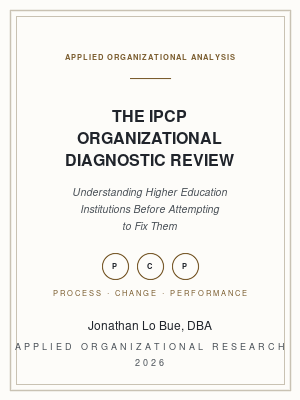
Most institutional improvement efforts fail for a simple reason: action precedes understanding. Leaders are trained to intervene quickly, but in complex organizations that instinct often treats symptoms while leaving root causes untouched. Grounded in the IPCP Framework, this diagnostic review is a structured method — inspection questions, diagnostic signals, and a synthesis discipline — for evaluating an organization's Process, Change, and Performance together, so leaders and boards can locate the real constraint before committing to an intervention, not after.
Read the review →Examines how leaders can balance urgency with operational clarity to address root causes, implement effective change, and achieve sustained performance improvement.
Explores how the IPCP Framework integrates process, change, and performance to help organizations align daily operations, improvement efforts, and measurable outcomes.
Examines how organizations can create operational clarity, manage change with discipline, and use performance feedback to continuously learn and improve.
Examines how organizations can turn performance data and stakeholder feedback into meaningful learning, informed decisions, and continuous organizational improvement.
Introduces an integrated approach to organizational improvement that connects effective processes, disciplined change, and performance measurement to strengthen organizational effectiveness.
Presents a structured approach to strategic planning that translates organizational goals into coordinated priorities, actions, responsibilities, and measurable progress.
A practical framework for assessing organizational health across the core areas that influence operational stability, performance, growth, and long-term effectiveness.
Jonathan is available for selected speaking, panel, workshop, executive education, and professional-development opportunities involving organizational leadership, change, and performance.
South College, Knoxville, TN — 2025. Doctoral capstone examined process, change, and performance as an integrated approach to institutional capacity and growth, producing the IPCP Framework.
Dr. Lo Bue is also a Board Certified Coach (BCC) in the Business & Executive Coaching specialty, a credential that supports his work in executive coaching, leadership development, and management development.
Graduate and undergraduate degrees in Business Administration also completed. Additional professional credentials are available in his complete résumé.
Executive leadership roles with two companies recognized on the Inc. 5000 during periods of significant organizational growth.